The TL:DR… I’m about to talk about Star Wars and the SAG-AFTRA strike. 😉
On July 13, 1923, the 50-foot high, flash-bulb popping “HOLLYWOODLAND” sign was dedicated in the Hollywood Hills of Los Angles County. Originally, a bit of a vanity project by a couple of street car tycoons and real estate barons to build an exclusive hillside community with not just upper-class homes and stately mansions, but tennis courts, markets, salons and stables for resident’s horses. The massive sign was erected to be the most visible billboard to attract newcomers to one of America’s fastest growing cities, which quickly became a hallmark for one of America’s fastest growing industries.
Hollywood.
Where “Happily ever after” is a destination.
100 years later, on July 13, 2023, the Screen Actors Guild & American Federation of Television & Radio Artist joined the Writers Guild of America and ceased production and promotion of all projects covered with the Alliance of Motion Picture & Television Producers. What this means is that almost every movie and most television shows, shows with performers who are members of the SAG-AFTRA union, are no longer being produced. Big budget blockbusters like Gladiator 2, Deadpool 3, and the sequel to the newest Mission Impossible movie have all ceased production. Television shows like Chicago Fire, Law & Order: SVU, NCIS, and The Simpsons, which would typically be in production for their fall seasons right now, as well as popular streaming shows like Andor and Stranger Things, have all shutdown. So clearly, if you’re a fan of television and movies, you might be slightly disappointed for a little while. Yeah, studios still have completed projects scheduled to be released, but there will be a noticiable delay on whatever your viewing pleasure might be.
So right now, you might be asking yourself…. what does any of this have to do with Star Wars?
I’m glad you asked!
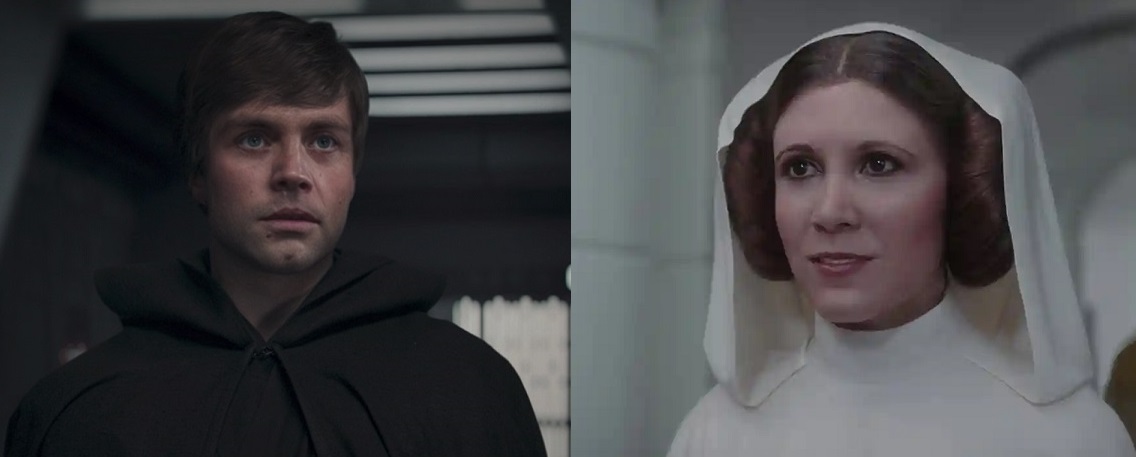
Back in 2016, Lucasfilm Limited and Walt Disney Studios released “Rogue One: A Star Wars Story” in theaters. If you’re not a fan, very briefly, Rogue One is a Star Wars movie, which acts as a spiritual pequel to the 1977 blockbuster Star Wars. As a prequel, this 2016 film used many of the same storylines, set designs and characters that were used in the original 1977 Star Wars. While storylines are timeless and sets can be recreated, characters that are played by actors and actresses in 1977 have age or otherwise not available to reprise their roles nearly 40 years later. And where some characters were recast with younger(and well, living) actors, the producer of Rogue One decided to use the budding technology of creating the digital likeness of certain characters. Peter Cushing, who played the villain in the original Star Wars, passed away in 1994. However, when you look at Rogue One, he was very prominently seen in the movie played by an actor whose face was not his own. Just the same with Carrie Fisher, who played Princess Leia in the 1977 movie. At the very end of the 2016 Rogue One, she shows up, not as the 60-year-old woman she was, but as the 20-year-old young woman she was in 1977. The thing is, while abbreviated and digitally articulated, Princess Leia, or at least Carrie Fisher’s face, was in Rogue One, but there’s one detail that was not in Rogue One. And that was Carrie Fisher herself. She was not credited in the film, which also means Carrie Fisher received a total of $0.00 from a film that grossed over one billion dollars in the box office. And this is part of the problem.
The other part of the problem deals with Princess Leia’s on-screen twin brother(here’s your 40-year-old Spoiler Alert), Luke Skywalker. Luke Skywalker was played by Mark Hamill. In 1977, Mark Hamill was 26 years old when audiences first saw him as Luke Skywalker. However, audiences last saw him as Luke Skywalker in 2020 and 2022, when he reprised the role in the streaming series “The Mandalorian” and “The Book of Boba Fett”. Those two shows took place a few years after the character was seen in the original films, which meant, like the actor, the character was to also be in his twenties. So, they also digitally recreated his likeness for these shows as well. However, the producer of these shows actually had Mark Hamill perform the scenes in the show, which means he is a credited performer and was paid for his work.
So what does this have to do with a bunch of overpaid actors going on strike?
I’m getting there! I promise!
A long time ago, in a studio far, far away from me, actually around the same time the Hollywood sign was originally erected, the executives of Hollywood studios held an enormous amount of power in the industry. Not very much different than now, but then, performers worked for the studio executives. They were for all intent and purposes, employers of those studios and as an employer they pretty much treated their employees, or actors, the way most employers would treat employees if left to their own devices, and that was pretty detestable. So, a group of actors including Boris Karloff(the guy who played Frankenstein) and Frank Morgan(the Wizard from the Wizard of Oz) along with several other actors and actresses created the Screen Actors Guild, a labor union to protect their rights as workers with studio executives and producers. And they all lived happily ever after…
For about 25 years.
Because at that time, a new invention started to gain traction in American households: Television. Now, Americans didn’t have to go out to theaters and pay to watch actors on screen. They could watch them on television in the comfort of their homes. Studios could sell their products to television networks to allow them to broadcast their films for content. And every time they did it, the studio would get paid a residual stipend with every showing. Do you know who got paid $0.00 for their work on those projects? Writers and actors.
So in 1960 they went on strike. And while it took several weeks for the actors(several months for the writers), eventually, the studio executives came to the conclusion that they were kind of being a bunch of tightwads and relented. They decided to give actors and writers a part of the residuals for work that is broadcast on television. And they lived happily ever after….
For like 20 years.
Because in the early 1980s, another new technology was entering homes across America: VCRs. Yeah, quite antiquated now, the industry was just getting off the ground in 1980. Much like television, studios could package their filmed projects and mass produce them on video tape and sell those video tapes to consumers who could watch their movies in the comfort of their own homes on their televisions. And of course, they received a residual payment for every single video they could sell to consumers. And do you know who got paid $0.00 for the work they did in those projects? Writers and actors.
So, in 1980 they went on strike again(the actors, writer’s struck in 1985 for the same reason). And in case you’re not keeping track, this has become a very visible and alarming pattern. Every time there’s a change in technology or a way entertainment is filmed or broadcast for consumers, film studios and mass media conglomerates of today are there to reap extremely massive rewards for what we give them. We want the content, and they are more than willing to find every way possible to give us this content. First it was by film. Then it was television. After that, it became home media. Now, the latest way to feed us our electronic opium is with the streaming of content and services. This has changed the game dramatically. For decades, since the first WGA and SAG strike of 1960, the formula for writers and actors to receive compensation on television was by episode. An episode is made, and they get paid. And, as structured, a television series would create and air a series for an order of 22 to 24 episodes a season. Of course, if a show runs weekly, that’s roughly six to eight months of compensation. Most people, like you and me, have to work 12 months to live normal lives. So what makes up for the other six months that they are not working are the negotiated residual paychecks that they receive when their work is broadcast on television. For example, I am a huge Law & Order: SVU fan and have probably watched every episode of the series. It stars Mariska Hargitay, who is paid per episode that is made. However, what has allowed me to watch every episode isn’t by watching it on NBC when it airs. But I’ve been able to catch up and watch on the USA network, ION and also MyTVZ. And every time Law & Order: SVU airs on those networks, Mariska Hargitay gets paid a residual income for work she did during filming of the show. Those additional airings supplements her income. And while Mariska Hargitay is very good and very prominent on the show, the reality is that the vast majority of actors on these series are not. The writers definitely aren’t either. So their compensation isn’t as high as many assume. They have to work for a living, which birth the term “working actor”. These are performers that find jobs and are looking for regular employment throughout the year. That is why network shows like Law & Order, Chicago Fire, NCIS, or The Simpsons, shows with long runs, are a reliable source of income for an actor. However, with the industry’s turn to an increase production on streaming content, this has changed. In fact, it has changed so dramatically that the actual workers in the industry have not remotely been able to keep pace.
The difference between network shows and streaming shows is the length. Whereas most broadcast shows are typically over 20 episodes, most streaming shows are less than half that amount. Broadcast shows were made to be vehicles for advertisment. Streaming services have no need to cater to advertisers to that extent, so they do not need to have seasons to span 6 to 8 months. They can be structured for shorter seasons, which could require 2 to 3 months of work. On top of that, the the studio can sell a show to a stream service and instead of the show being sold to and rerun on multiple network for continued income for the work that was actually done, writers and actors only receive a single residual from the streaming service. So not only are they working less, they are also receiving less income. So when Mark Hamill performed in The Mandalorian, he was paid for his work. But when I watch Luke Skywalker rip through a spaceship full of troopers 20 to 30 times a year, Mark Hamill isn’t paid 20 to 30 different times. He gets paid once.
On July 13, the same day the SAG-AFTRA strike was announced, the CEO of the Walt Disney Company, Bob Iger, did an interview with CNBC on the future of Disney as well as it’s relationship with consumers and labor disruptions. He said it was “disturbing” to him to see the writers and actors to go on strike and said that they are not being realistic in their expectations. This is keeping in mind that he is the CEO of the company that owns the film studio that hired Mark Hamill for his singular residual. I pay $10.99 a month for a Disney Plus subscripton, which allows me to watch Mark Hamill’s character destroy a hallway full of robots as often as I want. Bob Iger ostensibly receives residual income from my monthly subscription as I watch Mark Hamill’s character destroy a hallway full of robots every month. Mark Hamill received none of that. He does not receive income for his work that I consume and enjoy, nor would he receive income for the work he did that is digitally copied and used. If I write a book and that book is sold, I will receive income every time that book is sold. And I don’t need to personally write every copy I sell to receive that income. So why is it not realistic for someone to expect to be compensated for their work in the same way?
In Star Wars and Rogue One, the characters were fighting against the planet destroying monstrosity called the Death Star. There’s a line(written by a WGA writer and performed by a SAG actor) that asked what chance they have, and the character responded by asking what choice do they have. Bob Iger and other studio executives made the decision to change their business model to focus on streaming projects. This has made it harder for writers and actors to work and to live normal lives. Is there a chance that this strike affects the industry as a whole? Yes. But one side is living very comfortably, and the other side has members living check to check. Unfortunately, they really have no other choice… they deserve the chance to live happily ever after like the rest of us.
 Your Friendly Neighborhood Black Man