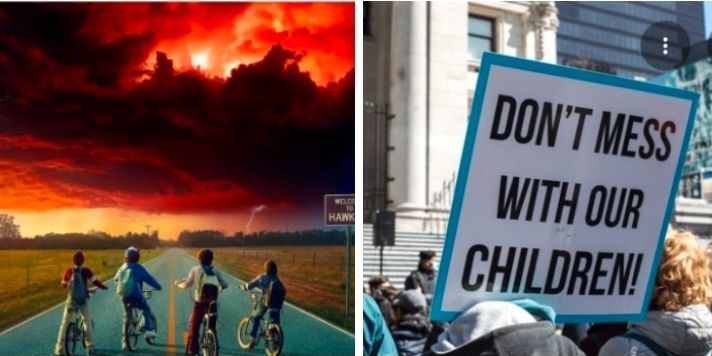
It’s time to grab you popcorn folks!
This week, Netflix releases the final episodes to its mega hit series STRANGER THINGS! This show is brimmed with mystery, wonder and thrilling excitement! Draped in heavy nods of nostalgia and familiarity, the show connects with audiences young and old. And I, for one, am eagerly looking forward to finishing the journey.
But for those living under a rock for the last 10 years, Stranger Things is about this group of kids growing up in the 1980s in a middle America small town. The kids get looped into a spiraling adventure with monsters from parallel dimensions, top secret government conspiracies and Cold War spy games. A large part of It’s success is due to the show leaning into classic 1980s era tropes and themes. And many of these themes circle around what kids in the 80s did and a game they played:
Dungeons and Dragons.
The first season started with them enthralled in a D&D gaming session. The villains of the series are named after monsters from D&D. The kids talked using terms found in the game, like calling their group their “party” and assigning archetypes from the game like “wizard”, “sorcerer” and “knights”. More pointedly, the show also tapped into what was happening in our society at large when referencing the D&D popularity. Later in the series, Dungeons & Dragons, along with the kids themselves, face backlash from the community around them that castigate the game as something malicious and those that play being prone to depravity and debauchery.
You see, the thing is, Dungeons & Dragons is a big game of make-believe. A table-top game where players pretend to be a character, along with other players who are also characters and they go and have an adventure. And while the genre of pretend can be virtually anything from science fiction to superheroes, the genre that birth it all was elements of fantasy fiction with knights, wizards, castles, and of course dungeons and naturally, dragons. Now, because this is make-believe and does not have a programmer designing a video game or a FX artist creating costumes and set-pieces for film, the heavy lifting is done by imaginative players facing whatever villain they can think of. The worst the bad guy is the more heroic they can be. And in a society grounded in deep and often intensely motivated Christian faith, what could possibly be worse than the biblical malefactors found in our Judeo-Christian beliefs? The very demons and devils that we’ve prayed against for years in churches across America.
So. In order to play the game, you have to use your imagination. And in order to use your imagination you have to know what you’re imagining. And to do that, Dungeons & Dragons players know the demons and devils they’re fighting. So, naturally, a nation full of gullible grown-ups were assuming a nation full of impressionable kids were learning how to worship Satan.
Queue the Santanic Panic.
Starting in the early 80s, pretty much right when Dungeons & Dragons took off in popularity, men, women and children across the country were accused of often heinous crimes and self-destructive behaviors which were invariably accompany by tenuous but often fabricated claims of Satanic worshipping or affiliations with groups or persons involved with such activities. In August 1979, James Dallas Egbert, a 15-year old child prodigy at Michigan State left classes and attempted suicide. When found by a private investigator, his disappearance was linked to Egbert’s playing Dungeons & Dragons and attempted act out in real life what the character would do in the game. Sadly, Egbert would follow through in an later attempt the very next year. In September 1983, Judy Johnson, a parent in Manhattan Beach, California, accused her son’s day care school owner, Virginia McMartin and her grandson Ray Buckey, of a myriad of allegations including abuse, sodomy, kidnapping and forced Satanic rituals. Multiple teachers and family members at the McMartin pre-school were arrested, the school vandalized and the Los Angeles District Attorney spent millions on their prosecution, the most ever spent on a criminal case in U.S. history. Ultimately there were no convictions and all charges were eventually dropped. In June of 1993, teenagers Damien Echols, Jessie Misskelley and Jason Baldwin were arrested in West Memphis, Arkansas for the murder of three elementary school kids. Based on a forced witness testimonies and evidence that the teenagers listened to heavy metal music, wore black clothing and had a passing interest in non-monothesistic, non-Christian religions, they were connected to a Satanic cult, which was reason enough for their conviction and imprisonment for over 17 years until it was realized there is no evidence to sustain a new conviction when presented with a new trial in 2010.
Even, in my corner of the world, I personally saw the effects of this panic in my own backyard. In 1991, a friend of mine’s little brother, along with a elementary classmate of his went missing. It would later be found that a high school classmate of my older brother, Shawn Novak, attacked and brutally murdered the two boys the day they went missing. When interviewed by police, they learned that the boys as well as Shawn Novak played Dungeons & Dragons and he used terms found in the game to describe the kids. Now, was it the reason why he attacked them? It absolutely was not. But was it the reason that were told in school the days and weeks after? Of. Course!
We live in a society, in a world, that is easily swayed by perceptions. Unfortunately, we are often at prey to those perceptions when guided by those that use their voice to push popular sentiments beyond belief and into social acceptance. This is further exacerbated when that belief is center around social norms and the moral foundations of our society. The Dungeons & Dragons generated Satanic Panic is just a single example. Concurrently, in 1985, the Parents Music Resource Center challenged the music industry for what they perceived to be song lyrics with violent, sexual and satanic themes in music. Artist like John Denver, Dee Snyder and Frank Zappa were brought before a Senate Committee to testify on the defense of their work. Shortly before this, Frank Zappa actually had a music video that was banned from MTV for over a decade until the equally controversial series “Beavis & Butthead” featured his video in an episode of the show. That show, which was coupled with emerging genres in videogaming was blamed for violent actions of impressionable kids in the early 1990s. When Golden Age comic book characters like Superman and Captain America became too tame for young readers who no longer needed a World War II-era savior, publishers started stocking newstands with horror-themed comic books. Along with changes in trends of music, there came a belief that an entire generation of teenagers were being lead to anti-social, self-destructive behaviors. This too was a similar moral panic in the 1950s and into the 1960s.
Coincidentally, there is through-line of each of these instances, of mainstream society attacking elements of culture or entertainment. Whether it’s Dungeons & Dragons, the McMartin Trial, Tales from the Crypt, Beavis & Butthead, Twisted Sister, Mortal Kombat and Doom, the one thing they all have in common is the perceived threat to the minds and well-being of children. It’s the scare tactic that pulls at the heart-strings of parents everywhere and pushes a society, gripped upon fear, to take any measure to legislate narrow-minded righteousness. Whenever there are children involved, any threat, legitimate or otherwise, can be brought under a societal microscope and the moral fabric of the society will drastically magnify any sign in an effort institute their ethics by their standards. And what was done in the 50s, 60s, 80s and 90s is now being done today, only the vehicle carrying the attack is not satanism, video games or music. Instead, it’s gender identity.
Two weeks ago, the School Board in Chesapeake Virginia, voted to approve a policy to prohibit any staff member from using any preferred names or titles and to only use pronouns that correspond with an individual’s biological sex at birth. This is just the latest salvo in a war that has been fought not just in Hampton Roads, but across the Commonwealth of Virginia and to the nation at large. Throughout the entire 2025 Gubernatorial campaign in Viriginia, the Lieutenant Governor, Winsome Earle-Sears repeated made remarks and comments about protecting girls having to share locker rooms with grown men. In multiple attack ads, mail pieces, social media post and interviews she accused Governor-Elect Abigail Spanberger of voting to harm little girls. Not to be out-done, the entire 2024 Presidential Campaign cycle was remarkably similar in the attacks against Vice President Kamala Harris. Vice President Harris campaigned on lowering the cost of living for everyday Americans, protecting voting and reproductive rights and criminal justice reform, but by October of 2024, over 95% of the ads from the opposition were negative and the majority of them focused on her support of the rights and freedom of Transgender men and women. It was made to be a divisive issue and the narrative that was used was the purposeful language of protecting children and little girls, not from little boys, but from “grown men”. This was bookended by Congress passing the Protection of Women and Girls In Sports Act earlier this year. The desire of lawmakers to protect children, specifically in bathrooms has picked up steam within the last ten years due to a case in Wyoming, where a Transgender woman assaulted the daughter of a family friend inside of their home. But because the attack happened inside of a bathroom within the residence, national media sources reported only the part regarding the bathroom and in some cases purposely and falsely reported it to be a public bathroom and the attention of an entire country focused on preventing Transgender women from using public facilities and it has not since abated.
For several years now, our society has seen Conservative Americans use children as the vehicle to target not just the Transgender community, but the overall LGBTQ Community as a danger that protection is needed from. There has been a multitude of activist, performers, entertainers and even lawmakers and educators who have just taking the simple stance of allowing for LGBTQ persons to simply exist as they are, they have been accused of grooming or psychologically conditioning children with the intent to sexually abuse them, or even enabling those who might. The idea that lesbian, gay, bisexual and Transgender persons are prone to abuse or harm children, or in the case of the latter, specifically identifying as such explicitly to cause harm is not a new tactic. But it is just simply the latest battleground in a historic legacy of societal outrage grounded in claims of immorality. Unfortunately, the true danger is not upon unsuspecting and impressionable kids. Those really in danger are the targets society selects to be the focus of their fear.
When Stranger Things completes it’s series, it will go out as one of the most viewed shows, not just on Netflix, but in television history. It’s popularity is undeniable. Millions across the world will watch these final episodes with high anticipation. But despite how popular the show has been throughout it’s entire run, the penultimate episode has ranked as the lowest rated episode of the series. On the Internet Movie Database, the online compendium of movies and television series, almost every single episode of the series is rated by the fans at 7 or 8 stars or even higher. However, in this episode, a character reveals to his family and friends that he likes alot of the same things they do, playing Dungeons & Dragons, riding bikes, going to the arcade, all the things they share, but he did not like girls the same way the others did. And in a show filled with moments of characters being embraced and loved and accepted by friends and families, which has given this show so much heart, this was indeed one of the best. But it’s clearly been targeted by a community that uses the same tactics of social backlash and blame of a kids game to attack their true target: those who dare to be different.
The human experience exist on a wide spectrum of identies and touchtones. Any combination of these make us uniquely who we are and who we are meant to be. And while we often appreciate and celebrate these differences, we live in a world where a mistrust and misunderstanding of those differences are weaponized against you. Time and time again, middle America has justified a morality-based outrage exclusively based on their minimalistic perceptions and very often it is said to be done to protect children. And since it uses the vulnerability of a child, they mask their outrage into panic and society of none the wiser. Unsurprisingly, it is often other children that are the actual targets adults use to justify their moral panics. And the games these adults play on these kids don’t involve dungeons or dragons. The danger is more realistic than any demon or devil ever could be. Their threat comes from thr very real world that we’re told is there to protect them but refuses out of rejection of those differences. And it’s not in a parallel dimension or a fictional small town. It’s in the very next door where you live right now.
 Your Friendly Neighborhood Black Man